

Back in 2012, I launched my first business. I’d spent years working in a bookstore, so I thought I knew everything.
And guess what? I failed — badly. By 2013, my partner was gone, and I was broke, embarrassed, and completely humbled.
That failure taught me more than any success ever could. It was a painful, expensive, and necessary wake-up call. I realized my problem wasn’t just a lack of money; I had the wrong mindset about money.
I had to build my new business, Wardoh Books, from scratch, alone. I sold my car. I got that $8,000 loan from my parents. I knew that money was my last chance. It would run out fast if I didn’t completely change my habits.
I started observing the successful people I already knew and admired, like my mentor Shen Xuan Hui and the shopkeeper Mr. Lim. How did they survive for decades while I failed in 15 months?
That’s when everything changed for me. I stopped thinking like a desperate failure and started thinking like a founder. Here are the real, hard-won lessons I learned during that painful rebuild.
Lesson 1: I Was Saving Backwards
The first and most painful lesson was that I was treating savings as an afterthought. With my old job, I would get paid, spend money, and then try to save whatever was left, which was usually nothing.
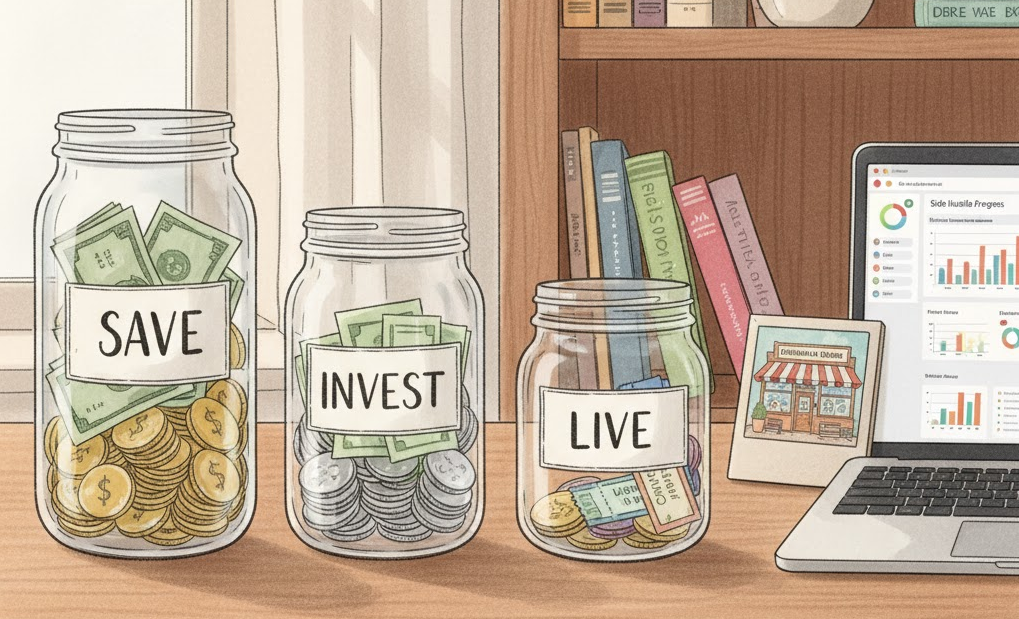
My successful mentors did the opposite. They “paid themselves first.”
With that $8,000 loan, I had to adopt this new mindset out of pure survival. This money wasn’t a paycheck; it was a lifeline.
- My Old Way (Scarcity Mindset): Get paid, spend on bills and fun, and save whatever’s left—if anything.
- My New Way (Wealth Mindset): Get a lump sum of capital (the loan), immediately set aside 70% for investment (printing, operations), and force myself to live on what’s left.
This simple shift was revolutionary. I stopped being “broke.” The money was allocated. This forced me to be frugal and taught me the discipline my first business lacked.
Lesson 2: I Was Relying on One Thread
When my first business failed, I was at zero. My one “thread” (the partnership, the single business model) had snapped, and I fell.
The successful people I was watching never had just one thread. They had multiple income streams. As one of my teachers said, “One thread is easy to break. But when you twist many threads together, you get a strong rope.”
During my rebuild, I realized Wardoh Books couldn’t just be one thing.
My main business was publishing (the “classics/educational” pivot).
But I also started a consulting/marketing service on the side to create a second, separate stream of cash.
This wasn’t greed; it was security. It was the foundation that allowed me to take smart risks, because a single failure wouldn’t wipe me out.
Lesson 3: I Was Working for Money, Not for Knowledge
This was the biggest mistake of my youth. In my first 10-year job, I worked for the paycheck. When the work was done, I went home.
When I was rebuilding Wardoh Books, my mindset was different. I was working to learn. I had to. I learned about marketing, negotiation, and client management—skills that became the foundation of my success. I taught myself design from YouTube. I learned about digital marketing.
I finally understood: my $8,000 loan could be lost. My car was gone. But the knowledge I was gaining—those skills are the only assets that no one can ever take from you.
The Real Takeaway
After my business failed, I could have given up. But the truth is, my business failed because my mindset was wrong.
I’m not telling you this to brag. I’m telling you because I was once exactly where you might be right now—confused, struggling, and not sure what to do.
The difference between my initial failure and my later success wasn’t a sudden gift of luck. It was a conscious decision to change my habits. I learned to pay my business first, to build multiple streams of income, and to never, ever stop learning.
You don’t have to change everything overnight. Pick just one of these ideas. That’s how it starts. Because the only thing holding you back isn’t your bank account—it’s your mindset.
