

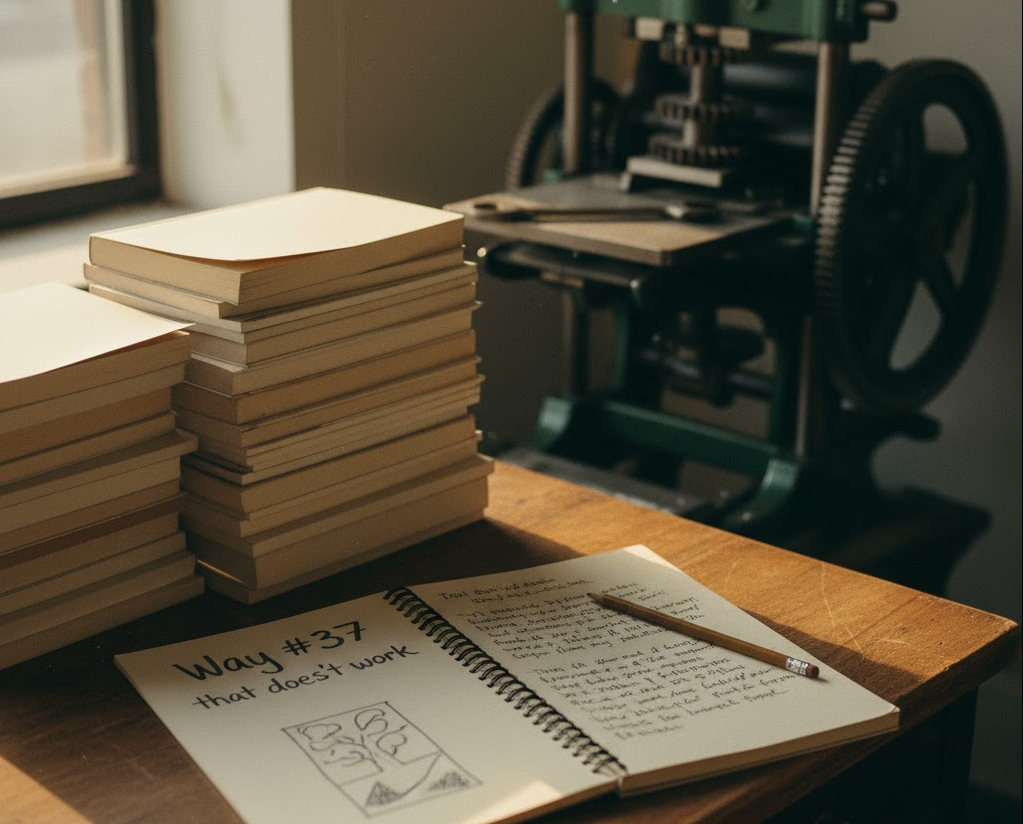
I can still picture the corner of my first office. In it sat a stack of books, gathering dust. They were my first published titles, and they weren’t selling. Across the room, our old printing machine was making a grinding sound again, a sure sign it was about to break down for the third time that month.
By most traditional metrics, my new publishing house looked like a failure.
I felt it in my gut every single day. The slow sales, the constant technical problems, and the cheap-looking book covers that I knew weren’t good enough. It would have been so easy to look at the evidence, call myself a failure, and quit.
But a quote from Thomas Edison was stuck in my head, and it forced me to ask a different question: What if this isn’t a failure? What if this is just me finding another way that doesn’t work?
That one question changed everything. It was the beginning of my own quiet revolution.
The Day I Decided to Become a Revolutionary
When I say “be a revolutionary,” I’m not talking about starting a war. I’m talking about overthrowing the government in your own head—the one that tells you you’re not good enough, that you’ve failed, and that you should just give up.
That day, surrounded by my unsold books and broken equipment, I decided to stop seeing my situation as a dead end. I decided to see it as a laboratory. Every problem wasn’t a verdict; it was just data. This wasn’t a story of failure; it was the story of me finding the 10,000 ways that didn’t work.
The Shark Mentality: Turning Problems into Experiments
There’s a saying that sharks die if they stop swimming. They have to keep moving forward to breathe. That’s the mindset I adopted. I stopped dwelling on the problems and started moving, turning each “failure” into a new opportunity for growth and learning.
Experiment #1: The Bad Book Covers. Instead of seeing “ugly, old-fashioned covers,” I reframed it as “Way #37 that doesn’t work.” The current design wasn’t connecting with readers. So, I started experimenting. I hired a young, hungry local artist whom I found on social media and gave her a simple brief: “Make something that you would want to pick up.” Her fresh, modern design for our next book caught people’s eyes. It started selling. I hadn’t failed; I had just been using the wrong visual language.
Experiment #2: The Broken Printing Machine. Instead of a “broken machine” that symbolized my doom, it was just “Way #112 that doesn’t work.” My current process was too reliant on faulty equipment. I couldn’t afford a brand-new press, so I spent a weekend on YouTube learning the basics of machine repair. I learned how to fix the most common jams myself. It wasn’t glamorous, but that small act of taking control—of refusing to be a victim of my circumstances—was empowering.
Experiment #3: The Slow Sales. Instead of thinking “my business has no sales,” it became “Way #256 that doesn’t work.” My old marketing methods weren’t reaching the right people. So, I stopped trying to guess. I started talking to the few customers I had. I asked them where they heard about us and what they wanted to read. Their feedback was brutally honest and incredibly helpful. I hadn’t failed at marketing; I had just failed to listen.
The Result: Why a Change in Thinking Changes Everything
It wasn’t an overnight success. There was no single moment of breakthrough. But slowly, with each small experiment, with each “way that didn’t work” that I identified and learned from, things started to change. The new book cover got attention. My ability to fix the printer saved us crucial downtime. Listening to our readers helped us create books they actually wanted to buy.
The business didn’t just survive; it began to grow. All because I made a conscious choice to stop calling myself a failure.
Your Turn to Start Your Revolution
If you’re out there, feeling like you’re failing, Maybe it’s time to pause—and ask yourself: what if this isn’t failure? You are not a failure. You are in the middle of a powerful learning process. You are simply discovering the ways that don’t work.
Look at one of your “failures.” Look at it honestly. Ask yourself:
- What is this teaching me?
- What’s one small experiment I could try?
- How can I keep moving forward—just for today?
That’s how the revolution begins. Not with a grand gesture, but with a quiet shift in how you see yourself.
You haven’t failed. You’ve just found another way that doesn’t work. And that is where all great stories begin.
